

Vertical Centrifuges
- Home
- Vertical Centrifuges
- All
- Vertical centrifuges
- Industrial centrifuges
- Pilot plant centrifuges
- Peeler centrifuges
- Manually discharged centrifuges
- Filtering centrifuges
- Decanter centrifuges
FREQUENTLY ASKED QUESTIONS ABOUT CENTRIFUGES
The basic types of centrifuges are classified according to the method used to separate solids from liquids.
Essentially, there are two physical principles of liquid-solid separation by centrifugation:
- Sedimentation (decanting) centrifuges (solid-bowl centrifuges)
These use the density differences between solids and liquids. The heavier solids settle against the inner wall of the closed drum.
- Decanter centrifuge: Continuous separation in which a screw conveyor discharges the solids. Ideal for high solid concentrations.
- Separators (disc centrifuges): Specialized in the separation of two liquids (e.g., milk skimming) or the clarification of liquids with low solids content.
- Tube centrifuges: Generate very high centrifugal forces for the finest particles (often used in laboratories or in biotechnology).
- Filtration centrifuges (screen centrifuges)
These function like a rotating screen. The liquid is forced outward through a perforated drum lined with a filter medium (cloth or mesh), while the solids remain behind.
- Peeling centrifuges: Typically operate in batches (in cycles). After drying, the solid cake is scraped off with a scraper blade.
- Pusher centrifuges: Continuous filtration in which a reciprocating pusher plate pushes the solid cake out of the drum.
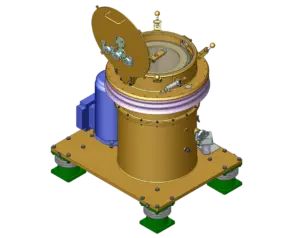
- Top discharge: design with manual discharge by scoop or through removable filtration bag
In summary:
Sedimentation (decanting) centrifuges have a solid wall (solid bowl), while filtration centrifuges have a perforated wall (perforated basket).
LEHMANN INDUSTRIE specializes exclusively in filtration centrifuges
The fundamental difference lies in the physical separation method: The decanter centrifuge uses the principle of sedimentation (difference in density), while the filter centrifuge relies on the principle of filtration (physical barrier).
Here is a comparison of the main features:
- Decanter centrifuge (sedimentation principle):
- Function: It separates substances based on their density difference. Heavier solids settle against a closed drum wall and are usually continuously discharged by an internal screw.
- Basket: Features a solid bowl (closed wall) through which no liquid can escape.
- Application: Ideal for suspensions with high solids content (“sludge”) and when continuous operation is important.
- Filter centrifuge (filtration principle):
- Function: The liquid is forced through a filter medium (e.g., a filter cloth or metal screen) by centrifugal force. The solids are mechanically retained and form a filter cake.
- Basket: Has a perforated wall (flow-through drum) so that the clarified liquid can drain out.
- Application: Preferred when a very high purity of the liquid or a particularly dry solid cake (dewatering) is to be achieved.
LEHMANN INDUSTRIE specializes exclusively in filtration centrifuges
Industrial filter centrifuges are primarily categorized by how they handle the solids discharge and whether they operate in a continuous or batch-wise manner.
- Batch-Type Filter Centrifuges
These machines operate in distinct cycles, including feeding, washing, spinning, and discharging.
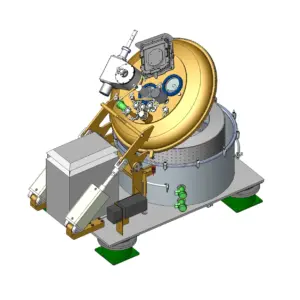
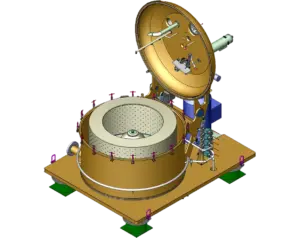
- Peeler Centrifuges: These feature a “peeler knife” that moves into the rotating drum to scrape off the solids cake once it is dry. They are common in chemical and pharmaceutical production for high-purity separation.
- Inverting Filter Centrifuges: These are specialized for the pharmaceutical industry because they mechanically turn the filter cloth inside out to discharge the product, ensuring no “heel” or residual layer remains behind.
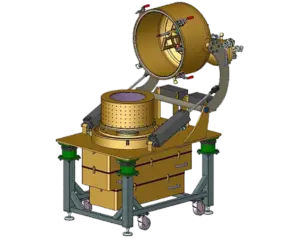
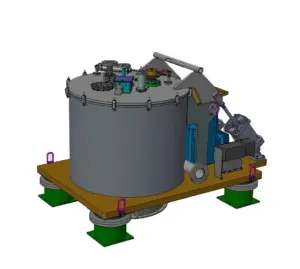
- Top discharge centrifuges: A simpler vertical design where solids are often manually removed or discharged via a removable filtering bag.
- Continuous Filter Centrifuges
These centrifuges are designed for high-volume, steady-state production without stopping for discharge.
- Pusher Centrifuges: An oscillating “pusher” plate moves the solids cake across a perforated basket while more slurry is fed. This creates a “moving bed” of material that discharges continuously at the end of the drum.
- Screen Scroll Centrifuges: These use an internal screw conveyor (scroll) that rotates at a slightly different speed than the drum to transport and discharge the solids continuously.
- Tumble/Sliding Discharge Centrifuges: These use the natural angle of the drum or specific vibrations to move solids toward the discharge area through centrifugal force alone.
Peeler centrifuges are batch-type filtration centrifuges primarily used in the chemical, pharmaceutical, and food industries for solid-liquid separation. Their most distinctive feature is a pneumatically or hydraulically controlled peeling knife that discharges the solid cake formed during the centrifugation process from the drum at high speed.
The 4 Phases of the Work Cycle
The process runs fully automatically in a fixed sequence:
- Filling: The suspension (liquid-solid mixture) is fed into the rotating drum. The liquid is forced out through a filter cloth, while the solids remain stuck to the wall as a “cake.”
- Washing: The solid cake can be cleaned with a washing liquid to remove impurities.
- Centrifuging: Maximum rotational speed minimizes the residual moisture in the cake.
- Discharging (peeling): A peeling blade enters the drum and scrapes off the solids while the drum continues to rotate. The material usually falls out through a chute or screw conveyor.
Main Types
- Horizontal Peeler Centrifuges: The industrial workhorse for bulk chemicals and fertilizers.
- Vertical Peeler Centrifuges: Preferred for pharmaceuticals because they are easier to clean and inspect (CIP – Clean-In-Place).
- Siphon Peeler Centrifuges: These use a siphon effect to create an additional pressure gradient, significantly speeding up the filtration process.
Typical Applications
- Chemicals: Production of salts, polymers (such as PVC), and fertilizers.
- Pharmaceuticals: Production of active pharmaceutical ingredients (APIs) and antibiotics under sterile conditions.
- Food: Processing starch (corn, potatoes) or sugar.
Pusher centrifuges are continuously operating filtration machines used to separate solids from liquids. They are specifically designed for processing large volumes of crystalline or granular materials.
Unlike peeler centrifuges, which work in batches, pusher centrifuges do not stop discharge material; they intake suspension and discharge dry solids at the same time.
How They Work
The process relies on a combination of centrifugal force and a reciprocating (back-and-forth) mechanical movement:
- Feeding: The slurry (mixture of liquid and solid) is continuously fed into the rotating basket through a feed pipe. A distributor accelerates the mixture to match the drum’s speed.
- Filtration: Centrifugal force pushes the liquid through a wedge wire screen, while the solid particles form a “cake” on the screen surface.
- The “Push” (Pusher Action): Inside the drum, there is a pusher plate (or an inner drum stage) that oscillates back and forth. With each forward stroke, it pushes the ring of solid cake a few centimeters toward the discharge end.
- Discharge: As the cake reaches the edge of the drum, it is thrown out into a collection housing. New solids are constantly being formed behind the cake as it moves forward.
Key Advantages
- Continuous Production: No downtime for filling or emptying, making them ideal for high-capacity industrial lines.
- Intensive Washing: The cake can be washed with high precision as it moves along the screen to remove impurities.
- Low Crystal Breakage: Because the transport is slow and steady, the crystals remain relatively intact.
Typical Applications
Pusher centrifuges are the “workhorses” for mass-produced chemicals and minerals:
- Salts: Processing sodium chloride (table salt), potassium chloride, or sulfates.
- Fertilizers: Handling large quantities of urea or ammonium sulfate.
- Plastics: Dewatering polymer granules like PVC or HDPE.