Address

Kirchenstraße 5, 85413 Hörgertshausen, Germany

System solution for chemical & plant engineering / Plastic container construction

Customized production of plastic containers & tanks and process equipment. For each project, we take care of the realization from the first draft, design & planning, the production, installation, and on-site commissioning.

Production is carried out in accordance with all European machinery directives and standards as well as the TÜV certificate DIN EN ISO 3824-2:

KEY FEATURES

Any size and thickness of material

Diameter up to 6 m/thickness up to 15 cm.

Even for highly aggressive media

Such as e.g. concentrated H₂SO₄, NaOCl, or HNO3.

Reliability and durability

Design life up to 50 years.

Completely recyclable

Small carbon footprint.

MATERIAL OF CONSTRUCTION

Plastic Description Temperature resistance

PP-H

Polypropylene Homopolymer

115 °C

PP-B

Block Copolymer Polypropylene

100 °C

PE-HD

 High-Density Polyethylene

80 °C

PVC

Polyvinyl Chloride

60 °C

PVC-C

Polyvinyl chloride chlorinated

95 °C

PVDF

Polyvinylidene fluoride

 140 °C 

FREQUENTLY ASKED QUESTIONS ABOUT PLASTIC TANKS

Plastic tanks offer several significant advantages over fiberglass (FRP) and metal (steel) tanks, often making them the preferred choice for storage and transport:

  • Corrosion resistance: Plastic tanks do not rust and, unlike metal tanks, are resistant to corrosion caused by water or chemicals.
  • Lightweight & Easy Handling: They are significantly lighter than metal or FRP tanks, which makes transport, positioning, and installation considerably easier—often without the need for heavy equipment.
  • Seamless construction: High-quality plastic tanks are often manufactured in a single piece (seamless) using the rotational molding process, which eliminates the risk of leaks at weld seams.
  • Cost-effectiveness: They are generally less expensive to purchase than stainless steel or high-quality FRP tanks.
  • Low maintenance: Due to the material properties, they do not need to be painted or protected against rust, which reduces long-term maintenance costs.
  • Flexibility & durability: They are impact-resistant, UV-stabilized, and durable (often 20+ years), while possessing a certain degree of flexibility that can be advantageous in the event of ground movement.
  • Environmentally friendly – plastic tanks can be fully recycled at the end of their service life

Our tanks made of thermoplastics, such as High-Density Polyethylene (HDPE), Polypropylene (PP), and Polyvinylidene Fluoride (PVDF) offer significant advantages over traditional metal or concrete tanks. These include superior resistance to chemicals and corrosion, low maintenance, lightweight design for easy installation, and high recyclability.

Our plastic tanks are manufactured from the following materials:

  • PP-H Polypropylene homopolymer – temperature-resistant up to 115 °C
  • PP-B Polypropylene block copolymer – up to 100 °C
  • PE-HD High-density polyethylene – up to 80 °C
  • PVC Polyvinyl chloride – up to 60 °C
  • PVC-C Post-chlorinated polyvinyl chloride – up to 95 °C
  • PVDF Polyvinylidene fluoride – up to 140 °C

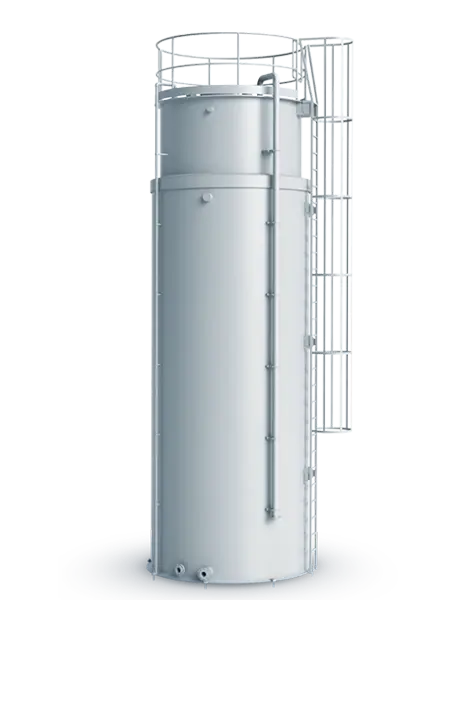
Our tanks made of thermoplastics, are manufactured from homogeneous, spirally wound pipes with large diameters ranging from DN 850 to DN 4,500 mm. We primarily produce upright, i.e., vertical tanks, for which there is no limit on height. The maximum standard volume is 200 m³.

However, we also manufacture horizontal tanks; the choice depends on whether they are to be installed above ground or underground. Generally, the wall thickness of horizontal tanks is greater. The maximum diameter for horizontal tanks is 3.5 m, with lengths of up to 15 m. For larger underground storage volumes, we interconnect multiple tanks.

For the production of rectangular tanks, we employ a welding technique that requires no additional filler material; specifically, this involves vertical butt welding.

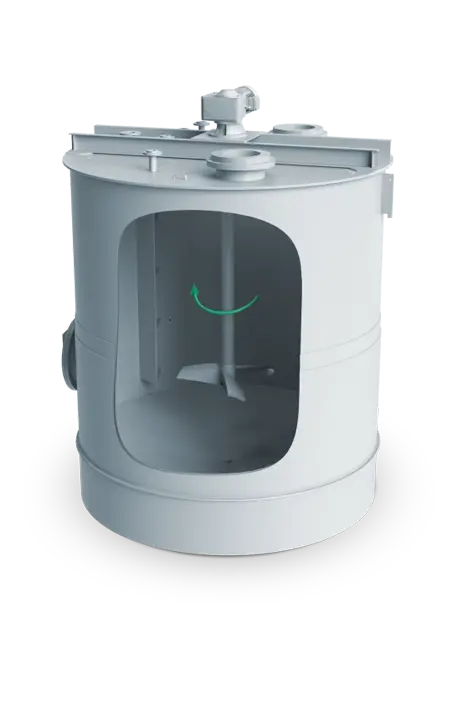
Cylindrical Process Tanks and Vessels feature conical bottoms, and their standard equipment includes agitators, heating and cooling coils, and aeration and spray systems.

Our plastic tanks are designed for a theoretical (minimum) service life of 20 years (with a safety factor of 2.0).

Our plastic containers and reactors are designed and manufactured in accordance with the following technical standards and regulations:

  • DIN EN 1778:1999-12 Characteristic values for welded thermoplastic constructions – Determination of allowable stresses and moduli for design of thermoplastic equipment
  • DIN EN 12573 Part 1-12 Welded static non-pressurised thermoplastic tanks 
  • DVS 2205 Calculation and design of thermoplastics tanks and apparatus
  • DVS 2207 Welding of thermoplastics 
  • Pressure Equipment Directive 97/23/EG (PED)

Only some thermoplastic tanks are UV-resistant. In general, polypropylene (PP) without UV stabilizers is not resistant to UV radiation when used as a material for tanks. In contrast, high-density polyethylene (PE-HD or HDPE) is often used for outdoor applications and is considered UV-resistant.

Tanks made of thermoplastics are generally intended primarily for solutions of corrosive chemical liquids, contaminated wastewater, etc.

The liquids most commonly stored in plastic tanks are:

  • Water-polluting liquids: many plastic tanks are specifically designed for the storage of non-flammable water-polluting substances.
  • Acids and alkalis: these include, among others, hydrochloric acid, sulfuric acid, acetic acid, formic acid, caustic soda, and caustic potash.
  • Chemicals and industrial fluids: dydrogen peroxide, ammonia solution, and various oils and lubricants.
Download a product catalog
Download