

Vertical Gypsum Peeler Centrifuges
- Home
- Vertical Gypsum Peeler Centrifuges
KEY FEATURES & OPTIONS
Vertical bottom discharge centrifuges type SCVB for chemical industry are designed primarily to process large volumes of product and to withstand high loads and operational requirements.
- Partially lid opening for easy inspection & maintenance
- Robust integral inertia plate design
- Main electric motor for top or bottom mounting
- Feeding pipe design that ensures optimum product distribution
- Hydraulically operated peeler (hydraulic unit)
- Peeler over the full height of basket with up-down motion
- Scraping knife blade with special wear resistance alloy (Stellite)
- Various cake detection devices
- RHR – Residual heel removal systems for complete product recovery
- Validated CIP [Clean In Place] systems
- ATEX Explosion-proof version (e.g. Ex II 2G IIC T4 or Ex II 2D IIIB) with inertization
- Local control panel with HMI operator terminal
- Profibus or Modbus connection to DCS dispatch panel
- AC variable frequency drive with a recuperation unit
- Various designs of bottom discharge chute extensions
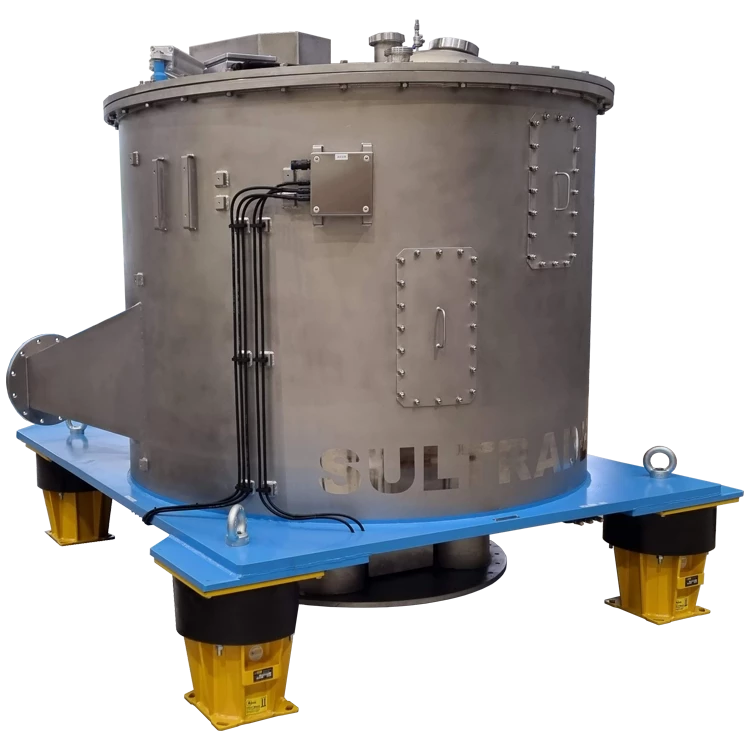
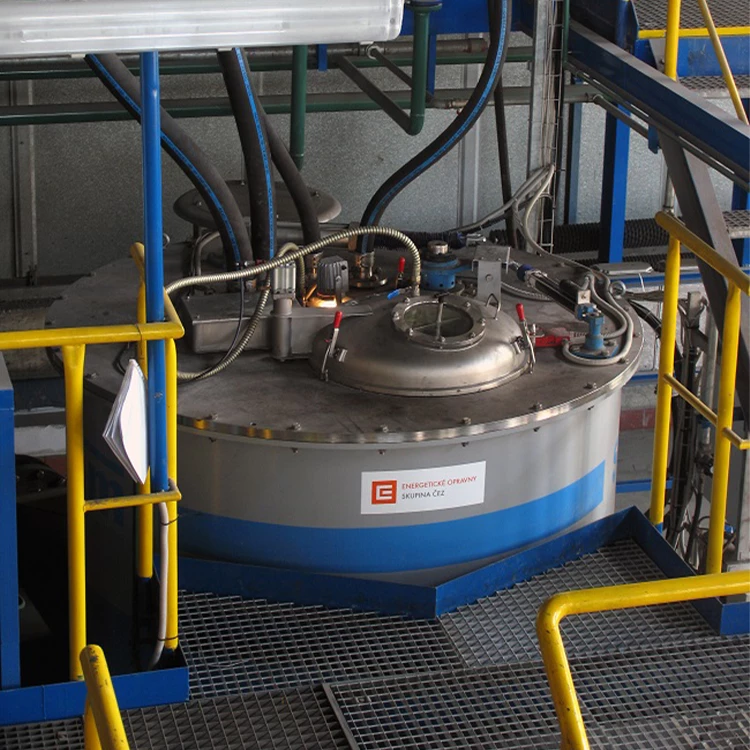
OUR VERSIONS OF GYPSUM CENTRIFUGES
Vertical gypsum peeler centrifuges are used in the dewatering lines both in the chemical industry after the neutralization of sulfuric acid and in flue gas desulphurization from coal-fired heating / power plants (FGD gypsum dewatering).
We design, manufacture, supply and install gypsum centrifuges of all sizes in innovative quality and with a possible CAPEX / OPEX investment financing. None of our competitors offer the gypsum centrifuges in the SCVB 1800/1250 size. Our centrifuges can be made entirely of stainless steel, avoiding the problems of rubberized parts (expensive repairs).
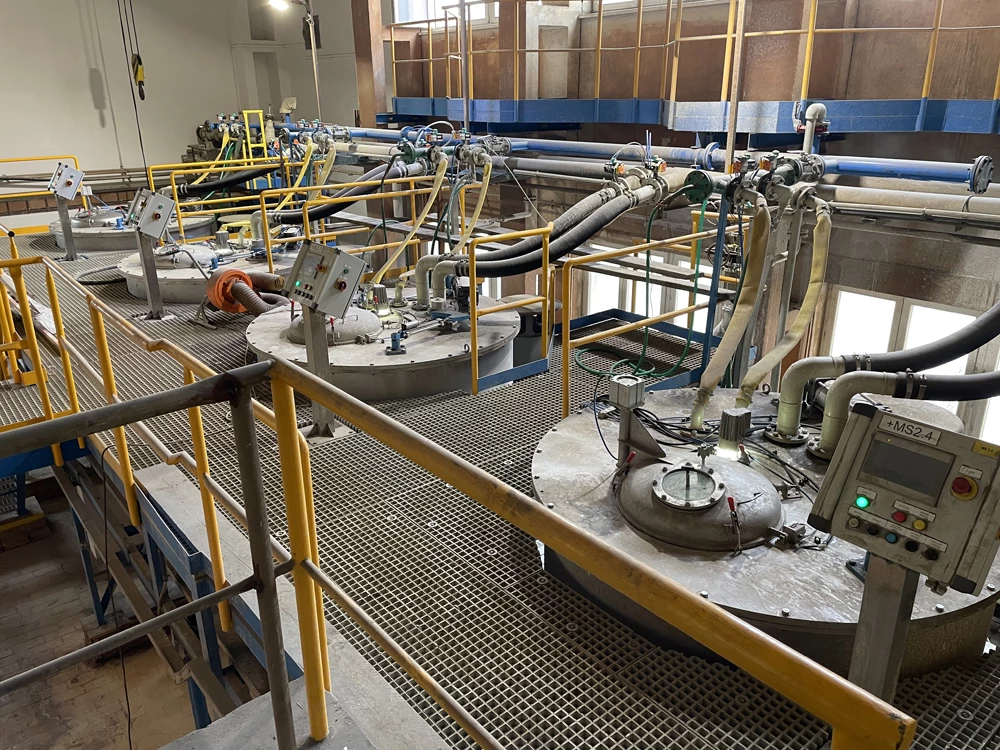
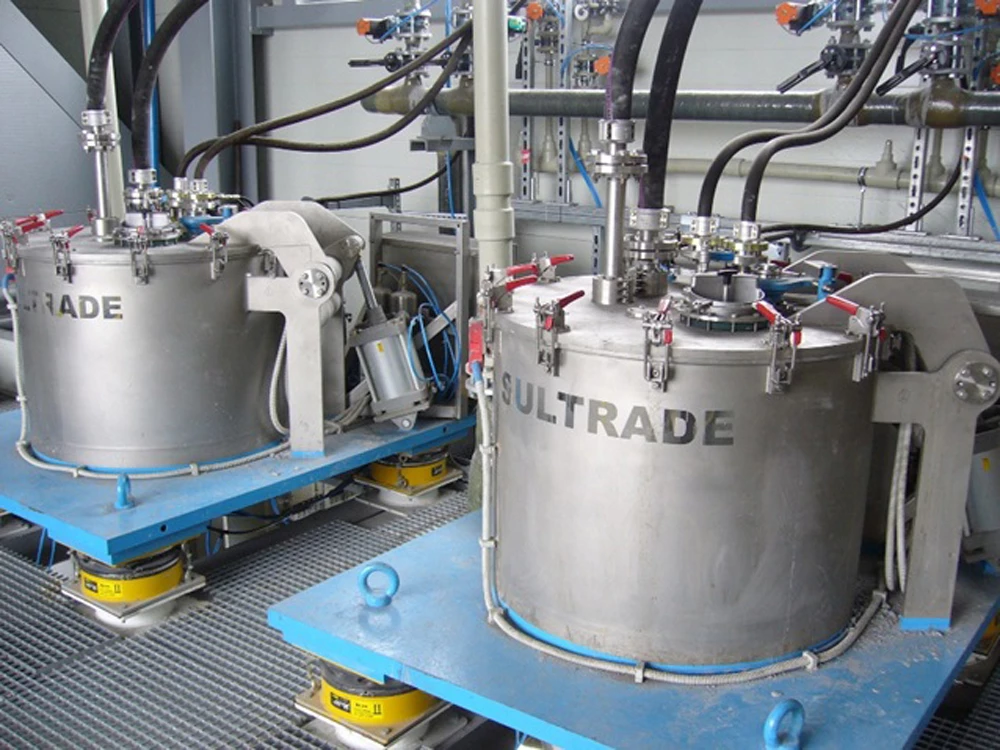
VERTICAL PEELER CENTRIFUGE DURING GYPSUM DISCHARGE
TECHNICAL CHARACTERISTICS
| Type SCVB | Basket ∅ [mm] | Height [mm] | Useful volume [L] | Load [kg] | Filtration area [m²] | Max. speed [rpm] | G |
|---|---|---|---|---|---|---|---|
630/400 | 630 | 400 | 64 | 80 | 0,79 | 1900 | 1271 |
800/500 | 800 | 500 | 128 | 160/223 | 1,26 | 1600 | 1145 |
1000/630 | 1000 | 630 | 252 | 315/438 | 1,98 | 1280 | 916 |
1250/800 | 1250 | 800 | 501 | 626/872 | 3,14 | 975 | 664 |
1250/1000 | 1250 | 1000 | 626 | 782/1089 | 3,93 | 975 | 664 |
1600/1000 | 1600 | 1000 | 1025 | 1282/1784 | 5,03 | 800 | 572 |
1600/1250 | 1600 | 1250 | 1282 | 1600/2230 | 6,28 | 800 | 572 |
1800/1250 | 1800 | 1250 | 1622 | 2000/2820 | 7,07 | 750 | 566 |
1800/1400 | 1800 | 1400 | 1817 | 2270/3160 | 7,92 | 750 | 566 |
FREQUENTLY ASKED QUESTIONS ABOUT GYPSUM CENTRIFUGES
Gypsum peeler centrifuge is a batch-type industrial filtration machine designed for solid-liquid separation. It processes gypsum slurry using high centrifugal forces to trap solids against a filter cloth while forcing liquid out.
Its main industrial application is in:
- Flue Gas Desulfurization (FGD): Dewatering synthetic gypsum byproduct in coal-fired power plants.
- Chemical Processing: Separating gypsum generated during the neutralization of sulfuric acid.
- Phosphate Fertilizer Plants: Managing phosphogypsum waste and byproduct streams.
LEHMANN INDUSTRIE supplies both the world’s smallest gypsum centrifuge (with a drum diameter of 630 mm) and the world’s largest, with a drum diameter of 1,800 mm and a capacity of up to 1 ton of gypsum per hour.
- Higher Reliability: Requires less backup machinery.
- Lower Space Requirements: Takes up roughly 1/3 of the floor space compared to vacuum belt filters.
- Drier Product: Reaches lower residual moisture levels through superior G-force.
- Filling: Slurry is pumped uniformly into the rotating basket, building a solid cake.
- Intermediate Spin: The basket accelerates to push out the initial main liquid volume.
- Washing: Wash liquid is sprayed onto the cake to rinse out chemical impurities.
- Final Dewatering: The machine spins at maximum speed to minimize residual moisture.
- Peeling: A mechanical blade swings into the rotating cake to scrape and discharge solids.
Why is the washing step critical for FGD gypsum?
It maximizes the removal of corrosive chloride concentrations. This produces high-purity gypsum suitable for commercial wallboard and plaster manufacturing.
It is a thin protective layer of gypsum intentionally left on the filter cloth. The peeling knife does not touch the cloth directly to prevent tearing or damage. The residual heel cake can become highly compacted and impermeable over several cycles. This traps fine particles and blocks liquid passage.
The residual cake is regenerated or removed by:
- Pneumatic Removal: High-pressure air or nitrogen blows the hardened layer off.
- Hydraulic Rinsing: Low-speed liquid flushing dissolves or shears the layer away.
- Backflushing: Specialized systems reverse liquid flow through the rotor to clear the cloth.
To avoid subsequent costs for repairing the centrifuge’s rubber lining manufacture we nowadays our gypsum centrifuges entirely from high-grade stainless steel or specialty alloys. This eliminates the risk of rubber lining degradation and subsequent shell corrosion. However, there are still customers for whom the rubber-coated version is essential due to the nature of the process, such as this example for a German waste-to-energy plant.