

Filter-dryers
- Home
- Filter-dryers
FILTER - DRYERS
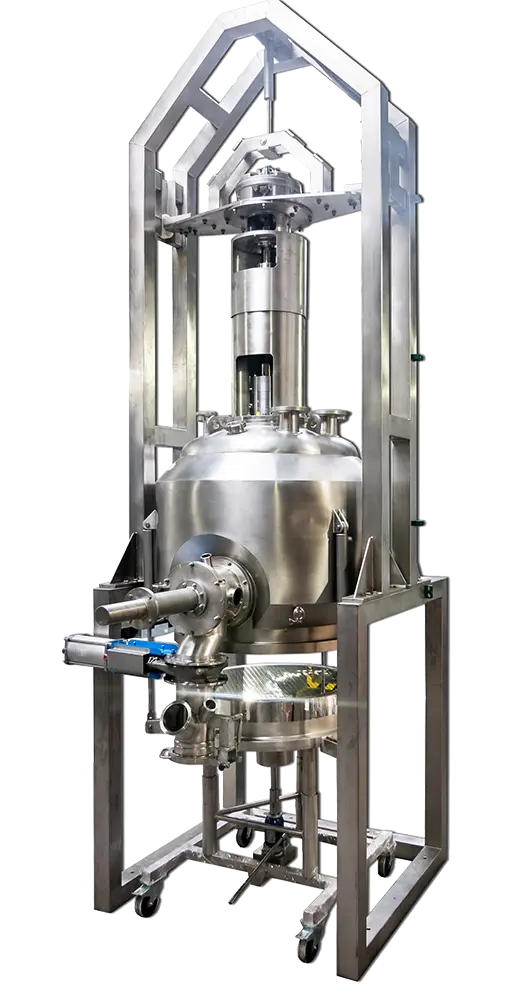
Company VSK has developed its own range of filter-dryers, used for numerous solid – liquid separation processes at various operational conditions, in chemical & pharmaceutical and other industrial branches.
KEY FEATURES & OPTIONS
- Operating pressure from -1 to 3 barg
- Operating temperature up to 200 °C
- Vacuum and/or heating
- Hydraulic agitator drive Bosch-Rexroth
- Bidirectional agitator with function “smooth” and “sweep”
- Adjustable speed of agitator 0 to 50 rpm
- Heated jacket, optional heating of the filter bottom
- Double mechanical seals
- Side mounted discharging port with manual or hydraulic clamping (optional discharging in the containment)
- Hydraulic lifting mechanism of the filtering bottom
- Axial lift of an agitator
- Dust filter with a shaker
- Cake washing
- Grinded or polished internal surface
- CIP / SIP washing and spraying systems
- CE certificate, PED (2014/68/EU) or ASME U Stamp, ATEX (2014/34/EU)
MATERIAL OF CONSTRUCTION
- Stainless steel (DIN 1.4571, DIN 1.4541, DIN 1.4301, …)
- Nickel, nickel alloy (Hastelloy®)
- PP, PVDF
- Coating (PFA RubyRed®, Halar® E-CTFE)
- Enameled stirrer and a side discharging port
DESIGN
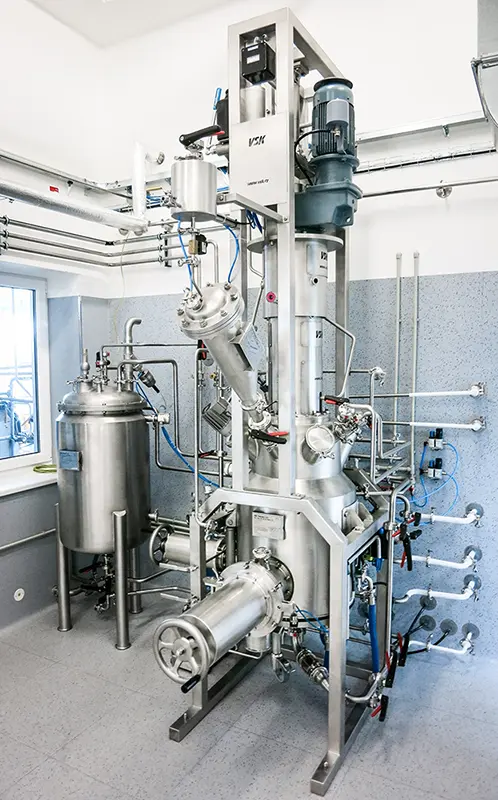
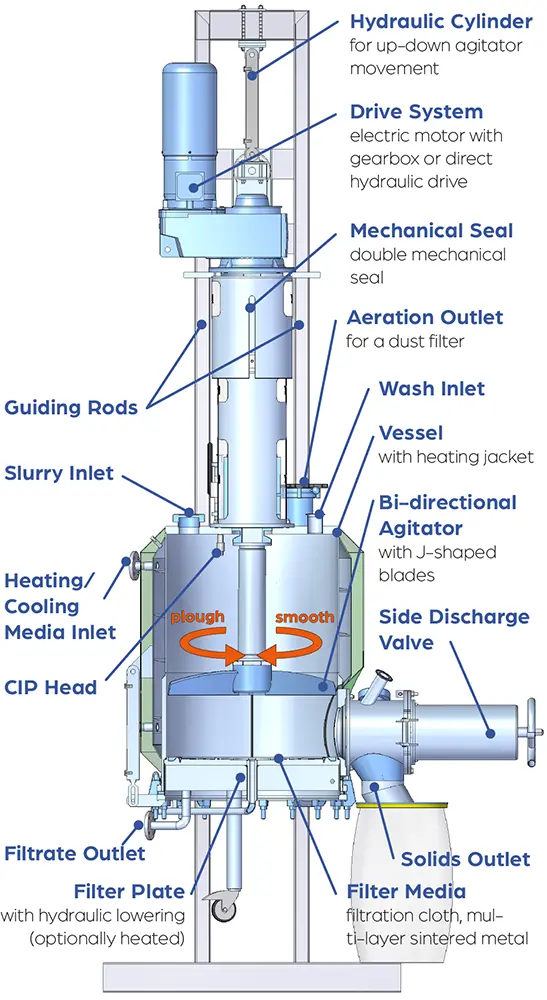
Agitated Nutsche Filter Dryer of the 100 liters volume, pharma, ATEX
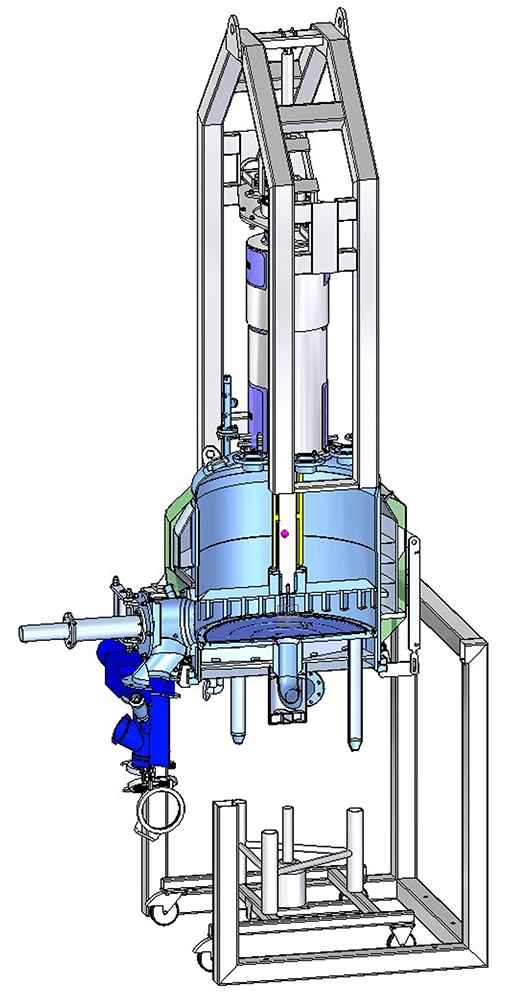
Agitated Nutsche Filter / Dryer works fully in an automatic way, consisting of the stirrer with J-shaped paddles with alternative rotation and vertical up-and-down movement. In clockwise direction it smooths, gently pressing the filter cake layer against the filter plate. In the counterclockwise direction it ploughs, assisting to the evacuation of the cake towards the side discharge valve. In addition, there is also a function of the filter plate hydraulic lowering.
Working Principle of the Agitated Nutsche Filter Dryer is described here: ANFD Working Principle | LEHMANN INDUSTRIE.
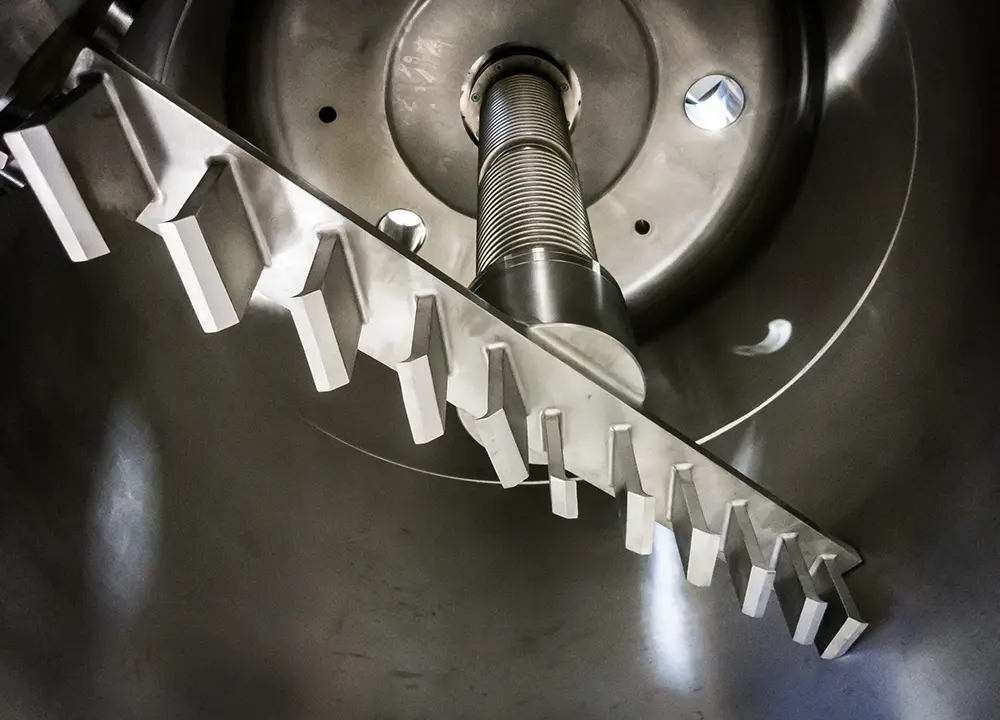
Stirrer with J-shaped paddles
TECHNICAL CHARACTERISTICS
| Filtration area [m²] | Diameter of apparatus [mm] | Volume above filter screen [L] |
|---|---|---|
0,08 | 400 | 60 |
0,13 | 500 | 100 |
0,20 | 600 | 200 |
0,40 | 800 | 400 |
0,65 | 1000 | 800 |
1,00 | 1200 | 1400 |
Data for information only. We design custom made equipment according to customer’s requirements | ||
FREQUENTLY ASKED QUESTIONS ABOUT NUTSCHE FILTERS
A nutsche filter (often simply called a Nutsche) is an industrial unit used for solid-liquid separation processes via filtration under pressure or vacuum. Applications: in the chemical, pharmaceutical, food, and cosmetics industries, from pilot to production scale.
Depending on their design, Nutsche filters are classified as Static Nutsche Filters and Agitated Nutsche Filters or Agitated Nutsche filter Dryers.
The nutsche filter consists of a cylindrical vessel with a flat bottom that serves as a filter plate. A filter medium (filter cloth or metal screen) is placed on this plate. The suspension is fed in at the top, and pressure differences draw the liquid (filtrate) through the filter, while the solids remain behind as a filter cake.
A static (or manual) nutsche filter is cylindrical vessel used for solid-liquid separation processes via filtration under pressure or vacuum. The vessel has a flat bottom that serves as a filter plate. A filter medium (filter cloth or metal screen) is placed on this plate, where slurry is filtered through and while the solids remain on the plate as a filter cake. Static Nutsche Filters means no stirring mechanism, using for the filtration just a static pressure difference. A common feature of these filters is the manual emptying of the cake through the upper part of the device, by opening the top lid. Depending on the diameter of the lid, the resulting mass and the type of application, several variants of lid opening are designed.
A nutsche filter can be used not only for filtration but also for washing and drying the filter cake. For this purpose, Automatic Nutsche Filter Dryer (ANFD) with a heating jacket for the heating medium are used.
An agitated pressure Nutsche filter (often referred to as an ANFD—Agitated Nutsche Filter Dryer) operates as a closed system for solid-liquid separation, typically in four cyclic steps. The basic principle is based on filtration under pressure or vacuum, supported by an integrated agitator for process optimization.
Working Principle of the Agitated Nutsche Filter Dryer:
- Mixing / Filling: At the start, the mixture (suspension) is fed into the filter vessel. The agitator, often equipped with J-shaped blades, homogenizes the material, aids crystallization, or ensures uniform distribution.
- Filtration: By applying pressure (above the suspension) or a vacuum (below the filter medium), the liquid (filtrate) is pressed through a filter cloth or plate. The agitator smooths the surface of the filter cake in a clockwise direction to prevent cracks and form an even layer.
- Washing / Drying: The filter cake is washed to remove impurities. The cake is then dried using gas pressure or a vacuum.
- Discharge: Once the process is complete, the agitator rotates counterclockwise. The special blades scrape the dry filter cake outward, and it is discharged through a side outlet valve.
Key Features:
- Fully automated process: The system enables mixing, filtering, washing, and drying in a single machine.
- J-agitator: It allows for both smoothing (clockwise) and discharging (counterclockwise).
- Height adjustability: The agitator can move vertically up and down to optimally process the cake.
This technology is primarily used in the pharmaceutical, fine chemical, and food industries.
The main advantages of an Agitated Nutsche filter Dryer (ANFD) compared to a Static Nutsche Filter revolve around efficiency, safety, and product integrity.
Here are the key benefits:
- Containment and Safety: ANFDs are fully enclosed systems. This prevents operators from being exposed to hazardous or toxic chemicals and protects sensitive products from environmental contamination.
- Integrated Processing: Unlike static filters, automatic versions can perform filtration, washing, and drying (often vacuum drying) within a single vessel. This eliminates the need to transfer wet cakes between different pieces of equipment.
- Reduced Labor and Human Error: Automation handles the agitation, cake discharge, and cleaning (CIP/SIP). This significantly cuts down on manual labor and ensures higher batch-to-batch consistency.
- Efficient Washing: The built-in agitator allows for “re-slurry” washing. By mixing the solvent directly with the filter cake, you achieve much more effective impurity removal than simple displacement washing in a static filter.
- Mechanical Discharge: Automatic filters use an internal paddle or screw mechanism to discharge the dry product. In static filters, the cake must be manually scooped out, which is time-consuming and risks product loss.
- Improved Heat Transfer: Many automatic units feature heated agitators and jackets, which speed up the drying process significantly compared to the passive air-drying or manual transfer required with static units.